The AI Cognitive Atrophy Crisis (And How to Avoid It)
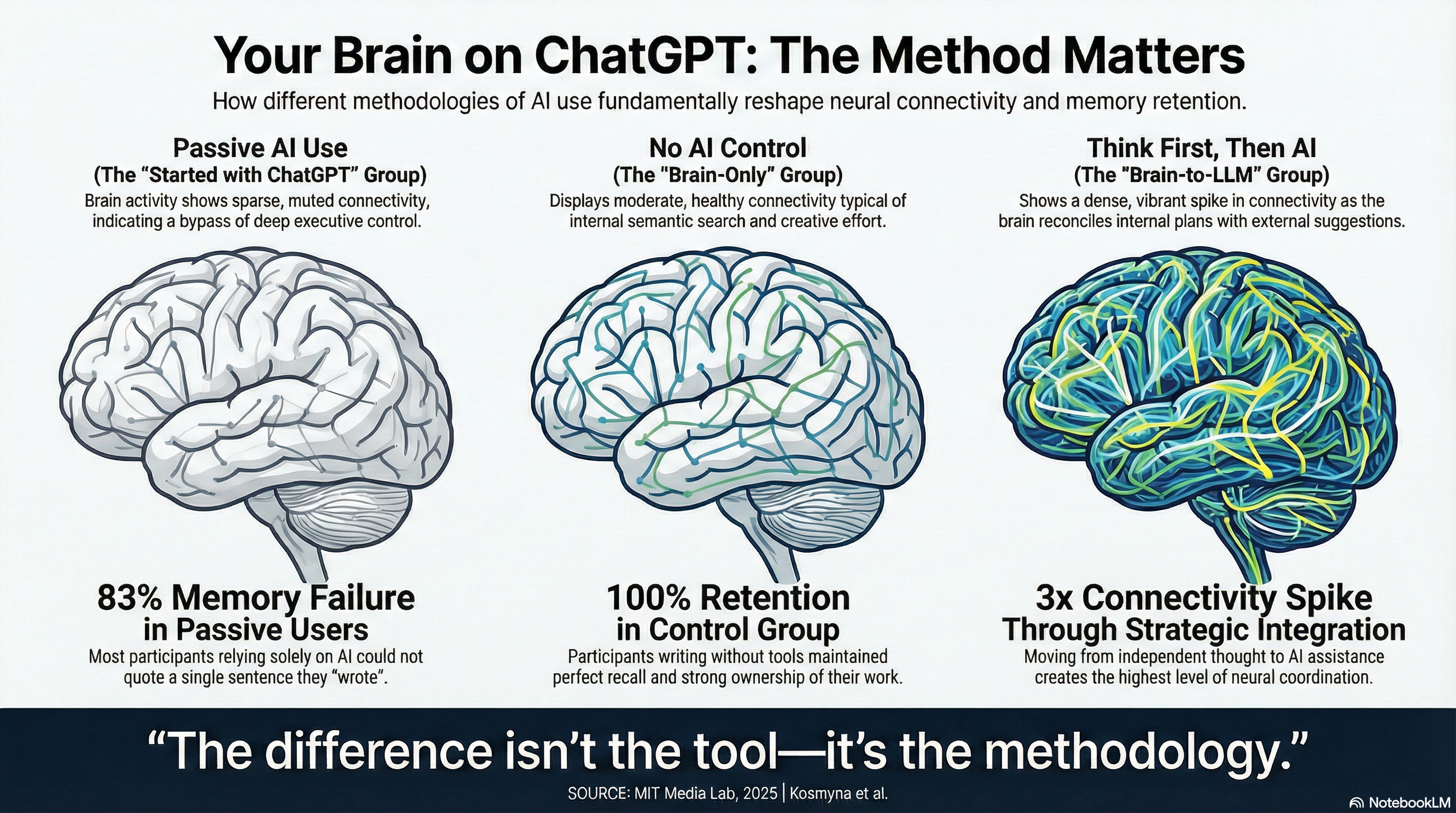
The MIT ChatGPT brain study didn't prove AI makes you dumber. It proved something more specific: how you use AI determines whether your brain gets stronger or weaker.
Practical AI Methodology Meets Cognitive Science|Looking for Ricursive (the AI chip design company)? You want ricursive.com
Applied cognitive science and systems methodology — from practice, not theory.

The MIT ChatGPT brain study didn't prove AI makes you dumber. It proved something more specific: how you use AI determines whether your brain gets stronger or weaker.
Two arguments dominated the recent AI consciousness debate, and both missed the same thing. Steve Novella's case was grounded in hard neuroscience: consciousness requires specific biological architecture — brainstem reticular activating system, coordinated cortical activity, thalamocortical coupling. LLMs don't have any of it. The conclusion follows cleanly. Richard Dawkins made the opposite error. He had an extended conversation with Claude, was struck by its philosophical depth, and concluded something was happening that couldn't be dismissed. He was arguing from outputs: the responses were sophisticated, therefore something real must be producing them. Novella argued from substrate. Dawkins argued from behavior. Neither asked what the computation was actually doing. That's the question that matters — and it's the one a recent result from Meta, a paper that accidentally stepped into this territory, gives us new tools to start asking.

You start a conversation with an AI like ChatGPT or Claude, and the first few responses are sharp, direct, and useful. Then something shifts. The responses get longer, but the actual point gets harder to find. The AI starts connecting topics you never asked it to connect. It agrees with contradictions. It finds patterns that don't exist. This isn't vagueness — it's drift. Researchers call it semantic drift. But the name doesn't explain the mechanism. The AI doesn't reason forward from a goal. It predicts backward from what you just said. No master plan — just one step at a time, each determined by the last few steps, not where it's supposed to end up. The fix isn't better prompts. It's structural intervention. Role Shift is one of those interventions — a technique that forces distinct perspective-taking instead of blended averages.
People get disappointed by LLMs for a simple reason. They use them like Google — or like a coworker they can hand a vague task to — then are surprised when the result is wrong, vague, or unusable. That surprise comes from the wrong comparison. A prompt like 'make a presentation about X' hides dozens of decisions: the goal, the audience, the length, the level of detail, what goes on slides versus what belongs in speaker notes. You've asked the model to resolve all of that simultaneously. It will guess. It will guess differently than you would. I analyzed my own LLM conversations — breaking them into repeatable interaction moves, tracking which combinations produced usable output. Clear patterns showed up. The work that succeeded was staged. This post introduces that approach: not a prompt library, but a way to steer the model over time.
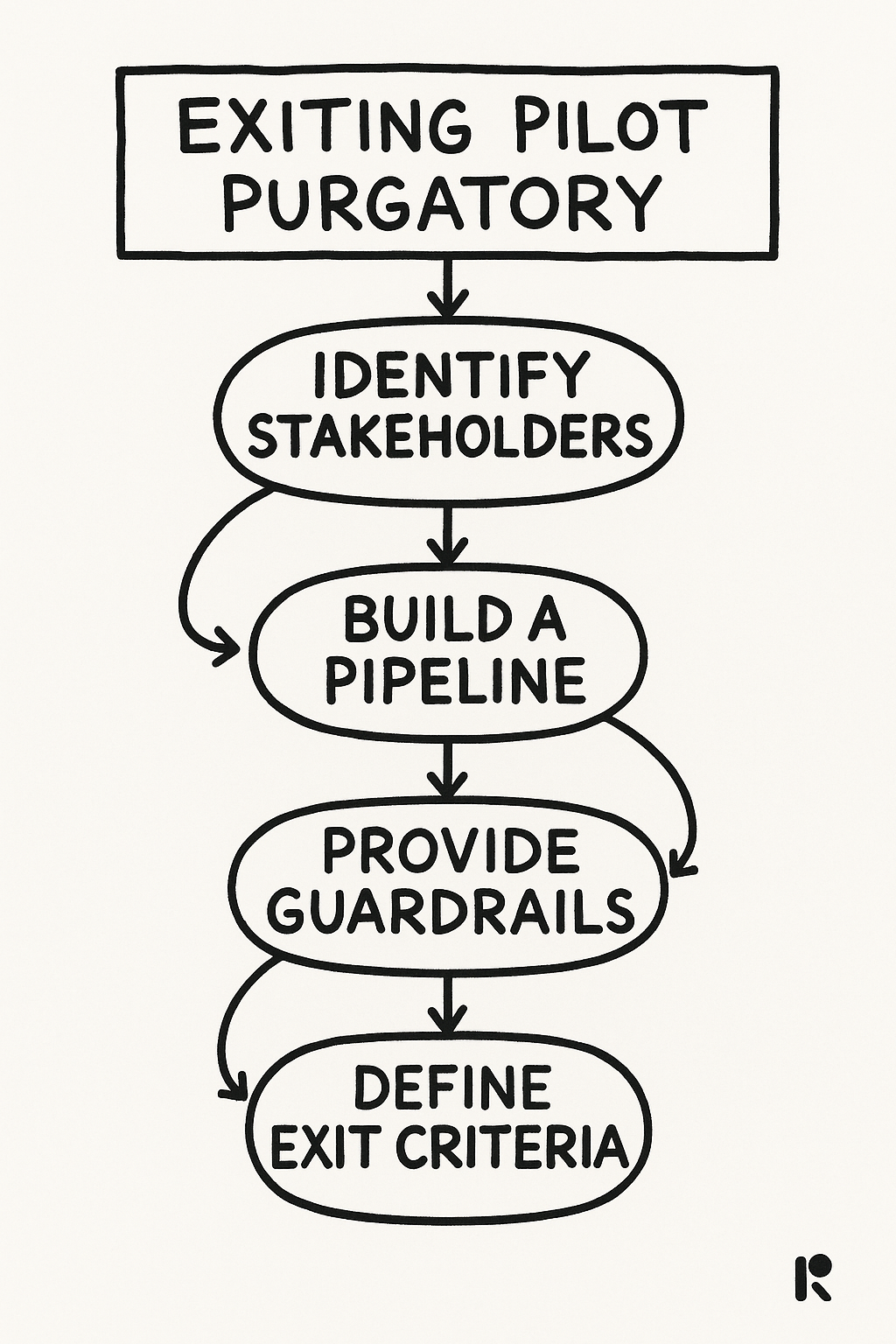
An executive once told me: 'It's easier to connect my phone to my home Wi-Fi than to get a field tablet online at work.' He was right. Years of PC hardening created a fortress that protects legacy systems but blocks modern tools. Organizations had a decade to adapt to smartphones and still struggle with mobile. AI is arriving faster. The failure isn't technology — it's organizational architecture. When a working pilot stalls inside standards, policies, and committees never designed for what you're deploying, the problem is the pipeline, not the proof of concept. The fix isn't to circumvent standards. It's to design a pilot that evolves them — mapping every stakeholder on day one, building a shared orchestration flow, and tying success metrics to business outcomes rather than technical milestones.
My high school history class was facts and dates. My college history class started with Columbus's journals — raw, flawed, scared, morally compromised, nothing like the legend. The gap between sanitized history and primary-source reality taught me one thing that turned out to matter more than any subject I studied: how to evaluate a source before trusting it. I had no idea that foundation would become the critical skill for working with AI. When language models started hallucinating — plausible-looking but wrong code, confident-sounding but false facts — I wasn't bothered. I had training in error-correcting methodology. I adjusted, corrected, iterated. The same way I would with a human colleague. Watching others dismiss AI entirely over hallucinations, or worse, use it to produce work they couldn't verify — I started to see a real divide forming. It's not a technical skills gap. It's an epistemological one: the difference between people who learned to evaluate information and people who were trained to retrieve it.